
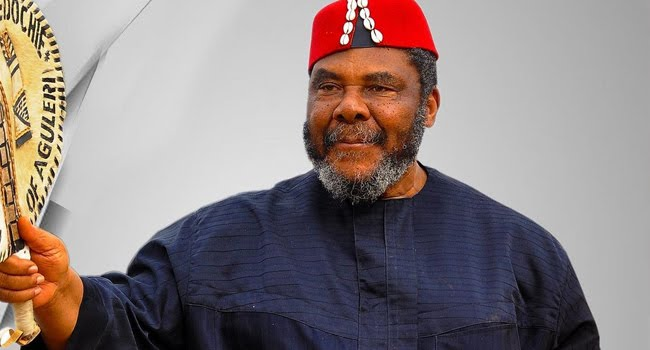
Some voices define an era. Pete Edochie’s does something rarer — it defines a people. His deep, resonant baritone, his commanding physical presence, and his extraordinary ability to embody the moral authority of the African patriarchal figure have made him not merely an actor but a cultural monument. For anyone who has grown up watching Nigerian television and cinema, Pete Edochie is practically synonymous with the archetype of the wise, formidable elder — a role he has played so consistently and with such evident conviction that it has become inseparable from his public identity. At 78, he remains one of the most recognisable and most referenced figures in the history of African storytelling.
Pete Edochie Biography
| Full Name | Chief Pete Edochie, MON |
| Date of Birth | March 7, 1947 |
| Age | 78 years old (as of 2025) |
| State of Origin | Anambra State, Nigeria |
| Nationality | Nigerian |
| Ethnicity | Igbo |
| Religion | Catholicism |
| Wife | Josephine Edochie |
| Children | Six, including actor Yul Edochie |
| Occupation | Actor, Former Broadcaster, Former Administrator |
| Education | St. John’s College; School of Journalism and Television, England |
| Honours | Member of the Order of the Niger (MON, 2003); Africa Film Academy Lifetime Achievement Award; AMAA Industry Merit Award |
| Known For | Things Fall Apart (NTA 1986 adaptation), Okonkwo role, cultural gravitas |
Early Life and Background
Pete Edochie was born on March 7, 1947, in Zaria, Kaduna State — a historically significant city in northern Nigeria with deep Hausa-Fulani cultural roots. His own roots, however, are firmly Igbo, from Anambra State in the southeast. The experience of growing up in the north with Igbo heritage gave him an early and unusual vantage point on Nigerian multiplicity — he understood, from childhood, what it meant to inhabit more than one cultural identity simultaneously. That kind of early cross-cultural navigation often produces in people a particular empathy and observational skill, and there is reason to believe it contributed to the universal quality of Pete Edochie’s performances: his ability to portray human dignity in ways that transcend any single ethnic or regional context.
He attended St. Patrick’s and St. James Primary School in Zaria, followed by St. John’s College for his secondary education. He later traveled to England to study at the School of Journalism and Television — an investment in formal media training that preceded his acting career and gave him a grounding in communication craft that would serve him well across both broadcasting and performance.
Before Acting: Broadcasting and Administration
Pete Edochie’s path to acting was not direct. He worked first as an administrator and then as a broadcaster, building skills in public communication, audience management, and the precise use of language and voice that broadcasting demands. These are skills that actors need but rarely develop through formal channels; for Pete Edochie, they were professional prerequisites long before they became artistic tools. His broadcasting background in particular — the need to be authoritative, clear, and compelling for a listening audience — surely contributed to the development of the voice that would later become one of the most famous in Nigerian cultural life.
The Defining Role: Okonkwo in Things Fall Apart
In 1986, the Nigerian Television Authority (NTA) mounted an ambitious television adaptation of Chinua Achebe’s Things Fall Apart — one of the most widely read African novels in the world, a story of the proud Igbo warrior chief Okonkwo whose uncompromising masculinity ultimately destroys him in the face of colonial disruption. The production was ambitious, the source material was sacred, and the role of Okonkwo required an actor of extraordinary physical and emotional stature.
Pete Edochie was cast, and his portrayal became definitive. His Okonkwo was proud without being cartoonish, rigid without being unsympathetic, and ultimately tragic in a way that honoured both Achebe’s text and the cultural reality it depicted. The performance was so powerful and so deeply felt that for most Nigerians who watched it — and millions did — Okonkwo and Pete Edochie became essentially synonymous. Even today, decades after the broadcast, any discussion of Achebe’s novel will almost inevitably reference his portrayal. It is, arguably, the most culturally significant single performance in the history of Nigerian television.
Career in Nollywood
When Nollywood emerged and exploded through the 1990s and 2000s, Pete Edochie became one of its most sought-after actors. His profile meant that his presence in any production immediately elevated its cultural credibility — he brought with him the weight of Things Fall Apart, the authority of his broadcasting career, and the almost mythological status of an elder figure in a culture that deeply values the wisdom of age.
He has appeared in hundreds of Nollywood films across multiple decades, almost invariably in roles requiring gravitas — patriarchs, chiefs, priests, traditional rulers, men whose words carry consequence and whose approval or condemnation shapes the lives of those around them. His deep voice, unhurried delivery, and physical authority make these roles feel natural rather than performed, and he has become the most frequently cast actor in this archetype in Nigerian cinema’s history.
In 2003, President Olusegun Obasanjo conferred on him the national honour of Member of the Order of the Niger (MON) — formal state recognition of his contributions to Nigerian culture. He received the Lifetime Achievement Award from the Africa Film Academy, the Industry Merit Award from Africa Magic, and in 2020 received the African Film Legend Award at the African Film Festival (TAFF). In September 2017, he endorsed the Wikimedia movement in Nigeria, appearing in a video to encourage greater use of Wikipedia among older Nigerians.
Personal Life
Pete Edochie is married to Josephine Edochie, and together they have six children. The most publicly known of their children is Yul Edochie, an actor who has built his own substantial career in Nollywood. Pete is a practising Catholic, a faith that has visibly shaped both his personal conduct and the moral seriousness he brings to his screen roles.
In 2009, Pete Edochie was kidnapped and later released unharmed by his captors — a frightening episode that highlighted the very real security challenges facing prominent Nigerians during a period of widespread kidnapping-for-ransom in the southeast. He handled the aftermath with characteristic composure, speaking about the experience without dramatising it unnecessarily.
Pete Edochie and the Meaning of Okonkwo
It is worth pausing on what Pete Edochie’s portrayal of Okonkwo actually meant, and continues to mean, to Nigerian and African culture. Chinua Achebe wrote Things Fall Apart as a direct response to Joseph Conrad’s Heart of Darkness — as a reclamation of African interiority and complexity against the dehumanising representations of Africa in Western literature. Okonkwo is not a simple hero; he is a deeply flawed, often cruel, and ultimately tragic figure whose rigidity destroys him. Playing that character convincingly — making audiences understand his pride without endorsing his violence, making his downfall feel like a loss and not just a punishment — required an actor of unusual psychological depth.
Pete Edochie gave Okonkwo that depth. His portrayal honoured the tragedy without simplifying it, and it gave generations of Nigerian schoolchildren watching the NTA adaptation a visual and emotional reference for one of the most important pieces of African literature ever written. That cultural function — helping a nation see itself in its most important story — goes far beyond entertainment. It is a form of public service.
Pete Edochie’s Influence on Nollywood’s Senior Generation
Pete Edochie’s influence on the generation of serious Nollywood actors who came after him is difficult to overstate. His combination of formal training, broadcast experience, and cultural rootedness created a standard for male dramatic performance in Nigerian cinema that has shaped what directors expect and what audiences respond to. Actors including Richard Mofe-Damijo, Olu Jacobs, and others from the industry’s serious dramatic tier all operate in a space that Pete Edochie’s Things Fall Apart performance helped define. His legacy is not just his own career but the standard he set for everyone who followed.
Pete Edochie’s Proverbs and Social Media
An unexpected dimension of Pete Edochie’s contemporary relevance is his social media presence — particularly his use of Igbo proverbs and traditional wisdom sayings in his posts and public communications. In an era dominated by quick takes and viral moments, his deliberate, measured use of traditional language has resonated powerfully with younger Nigerians who are interested in reconnecting with cultural heritage. His proverbs — some ancient, some apparently his own — circulate widely on Twitter and Instagram, introduced to new audiences who may never have seen his films but who encounter his wisdom through digital sharing. It is a form of cultural transmission that the television era could never have facilitated, and it has extended his cultural relevance into the lives of a generation that was not yet born when Things Fall Apart aired.
Frequently Asked Questions
How old is Pete Edochie?
He was born on March 7, 1947, making him 78 years old as of 2025.
What is Pete Edochie most famous for?
His portrayal of Okonkwo in NTA’s 1986 television adaptation of Chinua Achebe’s Things Fall Apart — considered the most iconic single performance in Nigerian television history.
Who is Pete Edochie’s wife?
His wife is Josephine Edochie. They have six children together, including actor Yul Edochie.
What national honour did Pete Edochie receive?
He was awarded the Member of the Order of the Niger (MON) by President Olusegun Obasanjo in 2003.
Is Pete Edochie Catholic?
Yes. He is a devout Catholic, and his faith is a publicly important part of his identity.
Disclaimer: All facts and accounts within this biography have been gathered from open-source materials. This content is offered for general informational purposes. Given the nature of public records, details may be subject to revision or correction over time.
Leave a Reply